How squash scoring works
 By the Find My Squash Court team·
Updated ·
5 min read
Squash scoring is simpler than tennis: every rally is worth a point, and the first to 11 wins the game. The few details that trip people up are the 10-all rule, which box to serve from, and how to call the score out loud.
The short answer
Squash uses point-a-rally scoring to 11, known as PAR 11. Whoever wins a rally scores one point, whether they served or not, and serves the next rally. The first player to 11 points wins the game, but at 10-all you must win by two clear points, so a game can finish 12-10 or 15-13. A match is usually best of five games, so the first to win three games wins. Some leagues and social matches play best of three.
Point-a-rally to 11
Under the World Squash rules, the winner of each rally scores one point and serves to begin the next one. It does not matter who served. If you are receiving and you win the rally, you get the point and the serve.
A game is played to 11. A typical game might go 0-0, 1-0, 1-1, 2-1 and so on, until one player reaches 11 with the other on 9 or fewer.
The professional association switched to point-a-rally scoring to 11 in 2004, the World Squash Federation confirmed it in 2009, and club squash followed. It made matches shorter and more predictable to schedule, and it means every rally counts, which suits spectators.
What happens at 10-all
If the score reaches 10-10, the game does not end at 11. Play continues until one player leads by two points. The marker calls "10-all: a player must win by 2 points" the first time it happens in a game.
So from 10-10 the game could finish 12-10, or it could carry on to 13-11, 14-12 and beyond. There is no tie-break and no cap. Long overtime games are rare but they happen, especially between evenly matched players.
"Game ball" is called when a player needs one more point to win the game, and "match ball" when they need one more to win the match.
Games and matches
| Format | Games to win | Possible results |
|---|---|---|
| Best of five | 3 | 3-0, 3-1, 3-2 |
| Best of three | 2 | 2-0, 2-1 |
Best of five is the normal format for tournaments and most league matches. Best of three is common in social play, some box leagues and early tournament rounds where time is short.
Players get up to two minutes between games. A game of PAR 11 between club players usually takes ten to fifteen minutes, so a best-of-five match fits in a 45-minute court slot only if it is fairly one-sided. How long is a squash match has more on timing.
Who serves and from which box
- A spin of the racket decides who serves first in the match. One player spins, the other calls "up" or "down" (or "rough" or "smooth" on older rackets) based on the logo or the strings.
- The winner of each game serves first in the next game.
- At the start of each game, and whenever the serve changes hands, the server chooses which service box to use.
- While you keep winning rallies, you must serve from alternate boxes: right, left, right, left.
- If a rally is a let, the server serves again from the same box.
If you lose track of the box, check with your opponent before you serve. In refereed matches the marker tells you. If a serve from the wrong box goes unnoticed, the rally still stands.
How to call the score
The server's score is always called first. So if you are serving and you lead 6-4, the score is "six-four". If your opponent then wins the rally, the serve changes and the call is "hand out, five-six", with their score first.
In social games the server usually calls the score before each serve. Say it clearly and wait for a nod. Arguments about the score are much rarer when both players hear it every rally.
Love, not zero. As in tennis, zero is "love" in squash. A new game starts at "love-all", and a score of 3-0 is called "three-love".
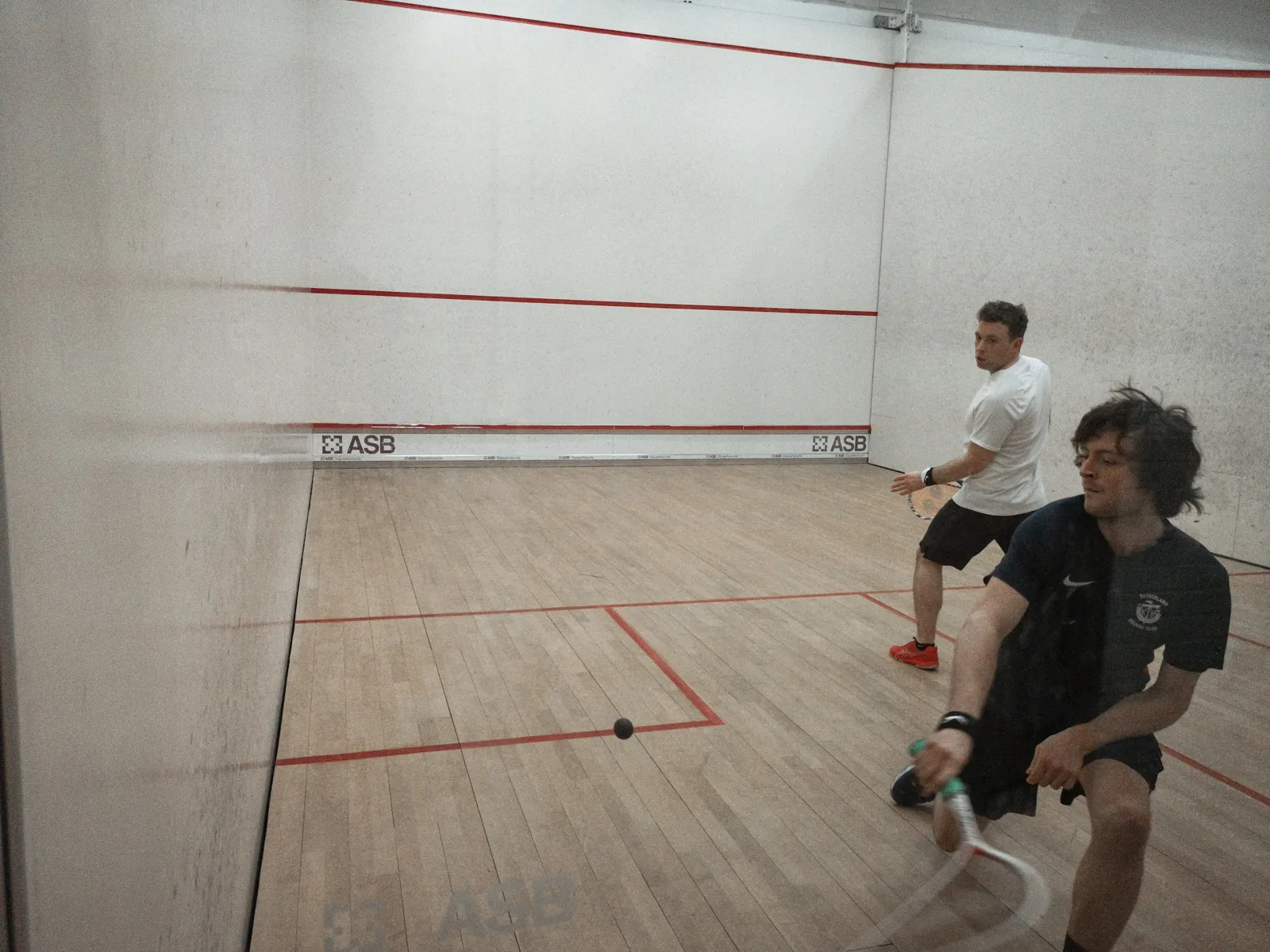
Sunderland Squash Club, Ashbrooke
Sunderland · Squash leagues

Club Kelburn (Club K)
Wellington · 7 courts

East Anglia Tennis & Squash Club
Norwich · Club leagues
Old English scoring
Before point-a-rally, squash in Britain and the Commonwealth used hand-in, hand-out scoring, also called English scoring:
- Only the server can score. If the receiver wins the rally, they win the serve but no point.
- Games go to 9.
- At 8-all, the receiver chooses whether the game is played to 9 ("set one") or to 10 ("set two").
Games under English scoring take much longer, because many rallies end with no change to the score. You still find it in some veterans' events, friendly club games and among players who learned that way. If someone suggests "proper scoring", agree the format before you start.
Scoring in leagues and club nights
Box leagues and club ladders use PAR 11 almost everywhere, but they differ in what they record. Some count games won, some count points, and some give bonus points for playing your match at all. Check the league rules before you play your first match, especially what happens if you run out of court time mid-match. Many leagues record the score at that point rather than replaying.
Squash box leagues explains how promotion and relegation usually work. Cities with the most squash leagues in our directory:
FAQ
What is PAR 11 in squash?
Point-a-rally to 11. Every rally wins a point for whoever wins it, a game goes to 11, and at 10-all a player must lead by two points to win.
Can you win a squash game 11-10?
No. If the score reaches 10-10 you must win by two, so the closest possible finish after 10-all is 12-10.
How many points do you need to win a squash match?
There is no points total. You need to win three games in a best-of-five match, or two in a best-of-three match.
Do you get a point when you are receiving?
Yes, under point-a-rally scoring. You also win the serve. Only under the old English scoring did the receiver win the serve without a point.