Squash court dimensions
 By the Find My Squash Court team·
Updated ·
6 min read
Every singles squash court in the world is built to the same plan, set by the World Squash Federation (WSF). Here are the exact measurements of the floor, the walls and every line, with the doubles and North American hardball versions alongside.
The short answer
A standard singles squash court is 9.75 m long and 6.4 m wide (32 ft by 21 ft). The out line on the front wall is 4.57 m high, the service line 1.78 m and the top of the tin 0.48 m. The back wall line is 2.13 m high. On the floor, the short line sits 5.44 m from the front wall, and each service box is a 1.6 m square. A doubles court is the same length but 7.62 m wide. The court needs at least 5.64 m of clear height over most of the floor.
Singles court dimensions
These are the figures from the WSF court specification. Wall heights are measured from the floor to the underside of each line, and every line is 50 mm wide.
| Measurement | Metric | Imperial (approx.) |
|---|---|---|
| Length of court | 9,750 mm | 32 ft |
| Width of court | 6,400 mm | 21 ft |
| Diagonal | 11,665 mm | 38 ft 3 in |
| Front wall out line | 4,570 mm high | 15 ft |
| Service line (front wall) | 1,780 mm high | 5 ft 10 in |
| Top of the tin | 480 mm high | 19 in |
| Back wall out line | 2,130 mm high | 7 ft |
| Short line to front wall | 5,440 mm | 17 ft 10 in |
| Short line to back wall | 4,260 mm | 14 ft |
| Service box | 1,600 mm square | 5 ft 3 in square |
| Width of all lines | 50 mm | 2 in |
The tolerances are tight. Length and width must be within 10 mm either way, measured one metre above the floor, and the tin must be within 2 mm of its correct height at every point. That is why a ball behaves the same way on a court in Leeds as on one in Perth.
The floor
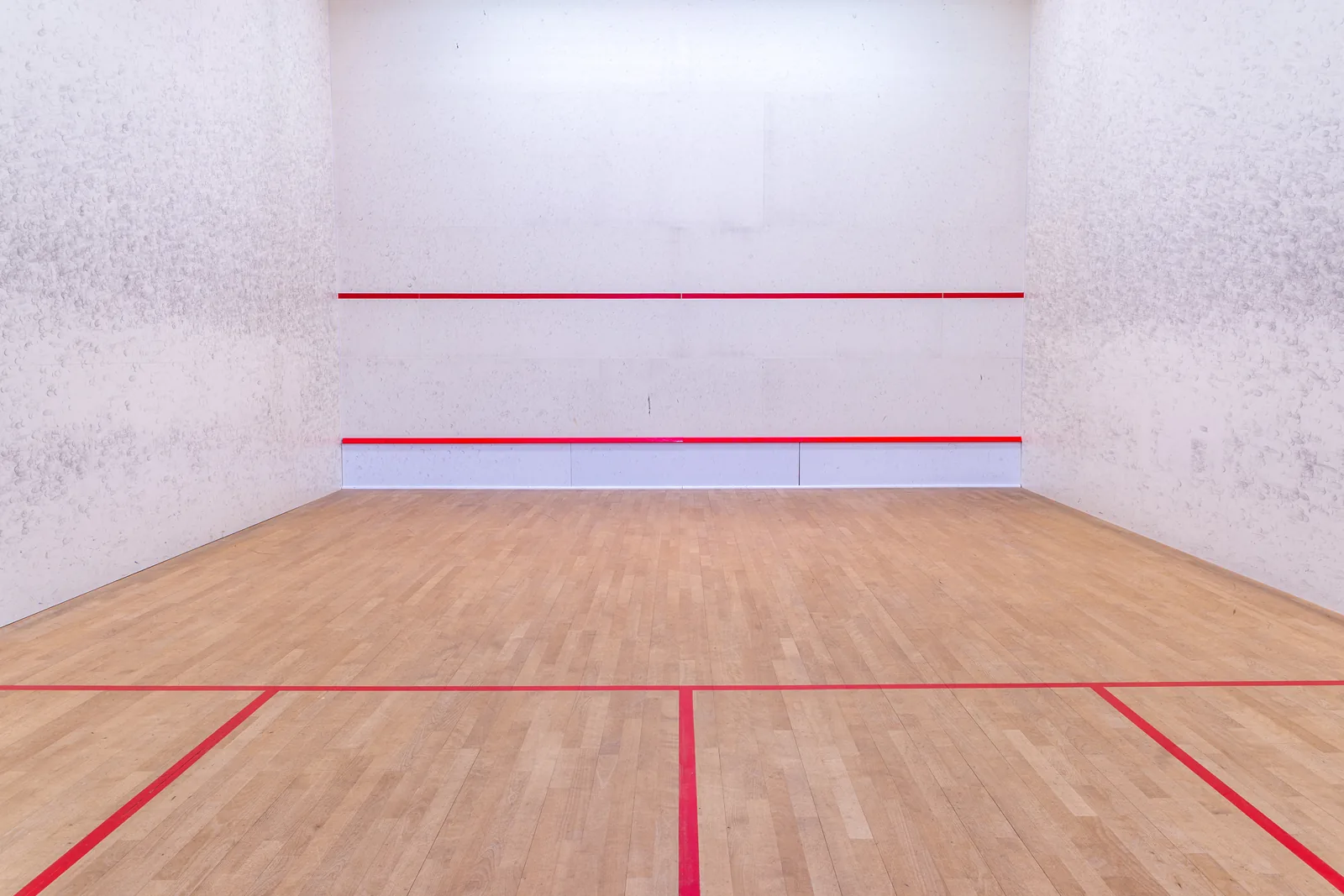
The floor is divided by two lines. The short line runs across the full width of the court, 5.44 m from the front wall to its front edge (4.26 m from the back wall to its back edge). The half-court line runs from the middle of the short line straight back to the back wall, splitting the back of the court into two quarters.
The two service boxes sit behind the short line, one against each side wall. Each is a square measuring 1.6 m inside the lines, closed off by the short line, a side wall and two more lines.
The floor is usually sprung timber, though the World Squash specification also covers synthetic and composite floors. It must have a matt finish, either natural wood or a colour light enough to reflect at least half the light, so the ball bounces evenly and players do not slip. The point where the short line meets the half-court line is called the T.
The walls and their lines
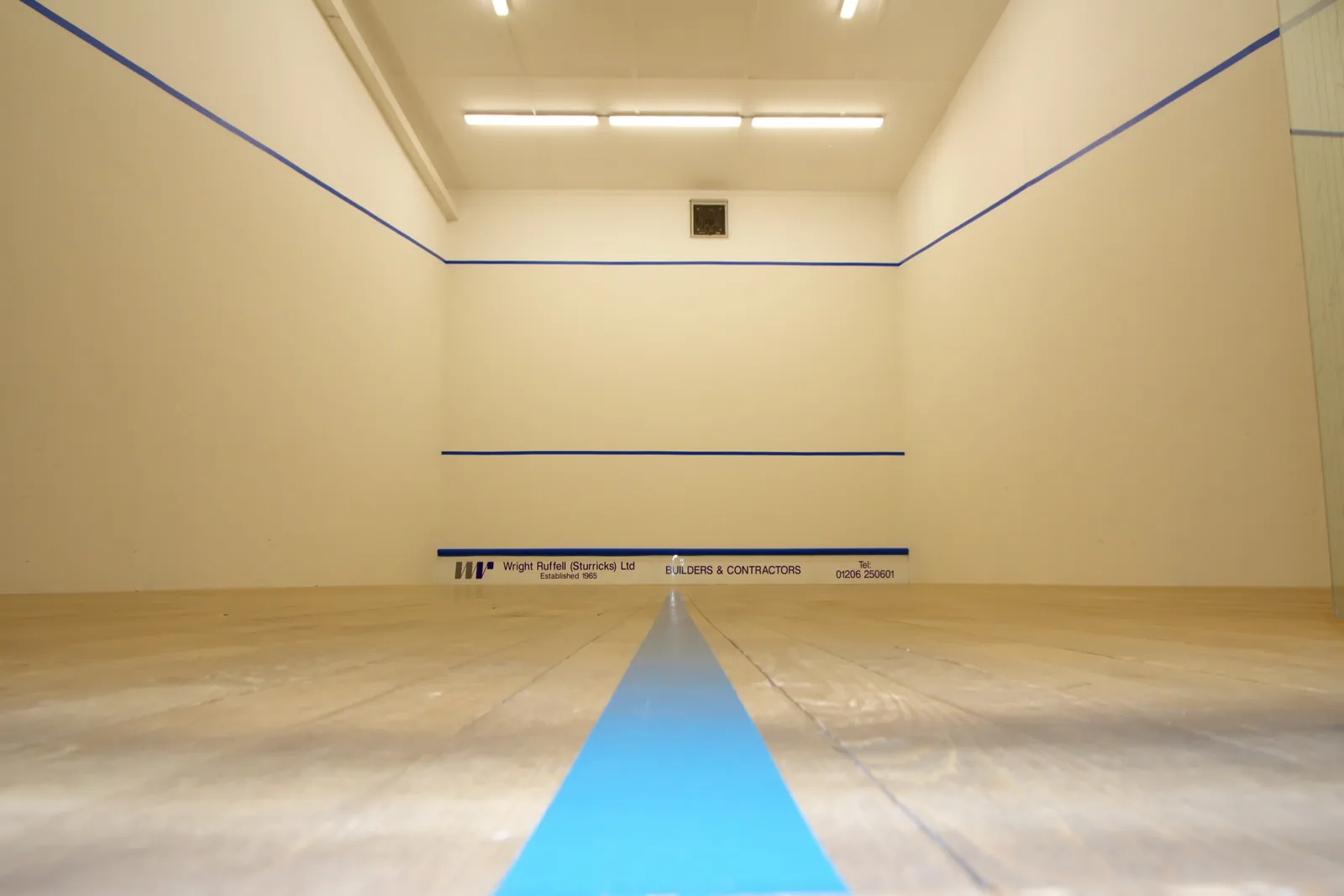
The front wall has three markings:
- The out line at the top, 4.57 m above the floor.
- The service line, 1.78 m up. Serves must hit the wall above it.
- The tin, a strip running the full width of the wall from the floor up to 0.48 m. It is built to make a distinctive noise when the ball hits it, and its top 50 mm is shaped to deflect the ball.
The side walls each carry one diagonal out line, joining the top of the front wall line to the top of the back wall line. The back wall has one out line at 2.13 m.
Professional events often lower the tin to 430 mm (17 in), which rewards attacking shots and shortens rallies. The WSF specification notes this is preferred for tournaments on the PSA professional tour, and recommends an adjustable tin on any court likely to host events. Club courts almost always use 480 mm.
What each line means during play, and what happens when the ball touches one, is covered in squash court lines and the tin.
Ceiling height, door and temperature
- Clear height: at least 5.64 m above the playing area, measured to the lowest light fitting or grille. It can taper to 5 m within a metre of the front wall and to 4 m over the last 3 m in front of the back wall.
- Door: in the back wall, between 750 mm and 900 mm wide and 2.13 m high, so it fits under the back wall line.
- Temperature: the heating should keep the court between 15°C and 25°C, with 18°C to 20°C as the ideal. A cold court makes the ball slow and dead.
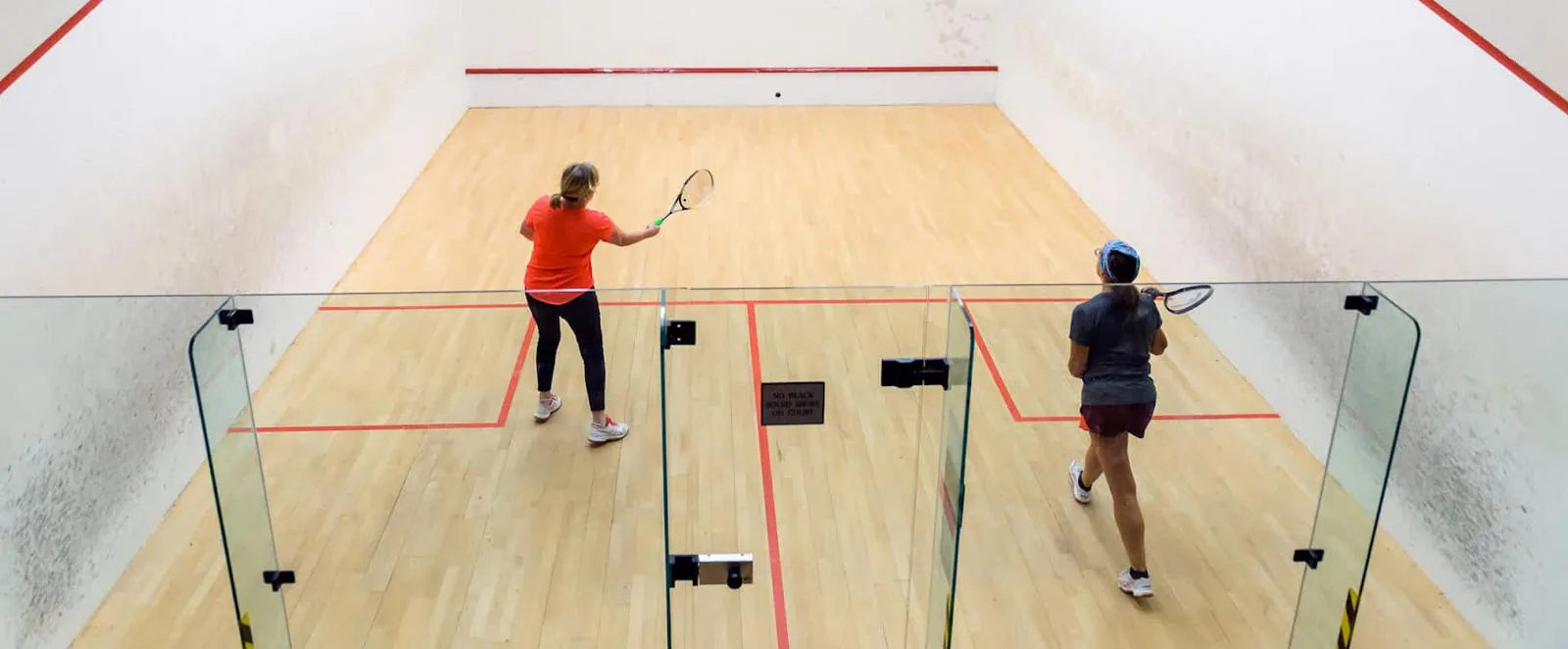
ALSAA
Dublin · Glass-back courts
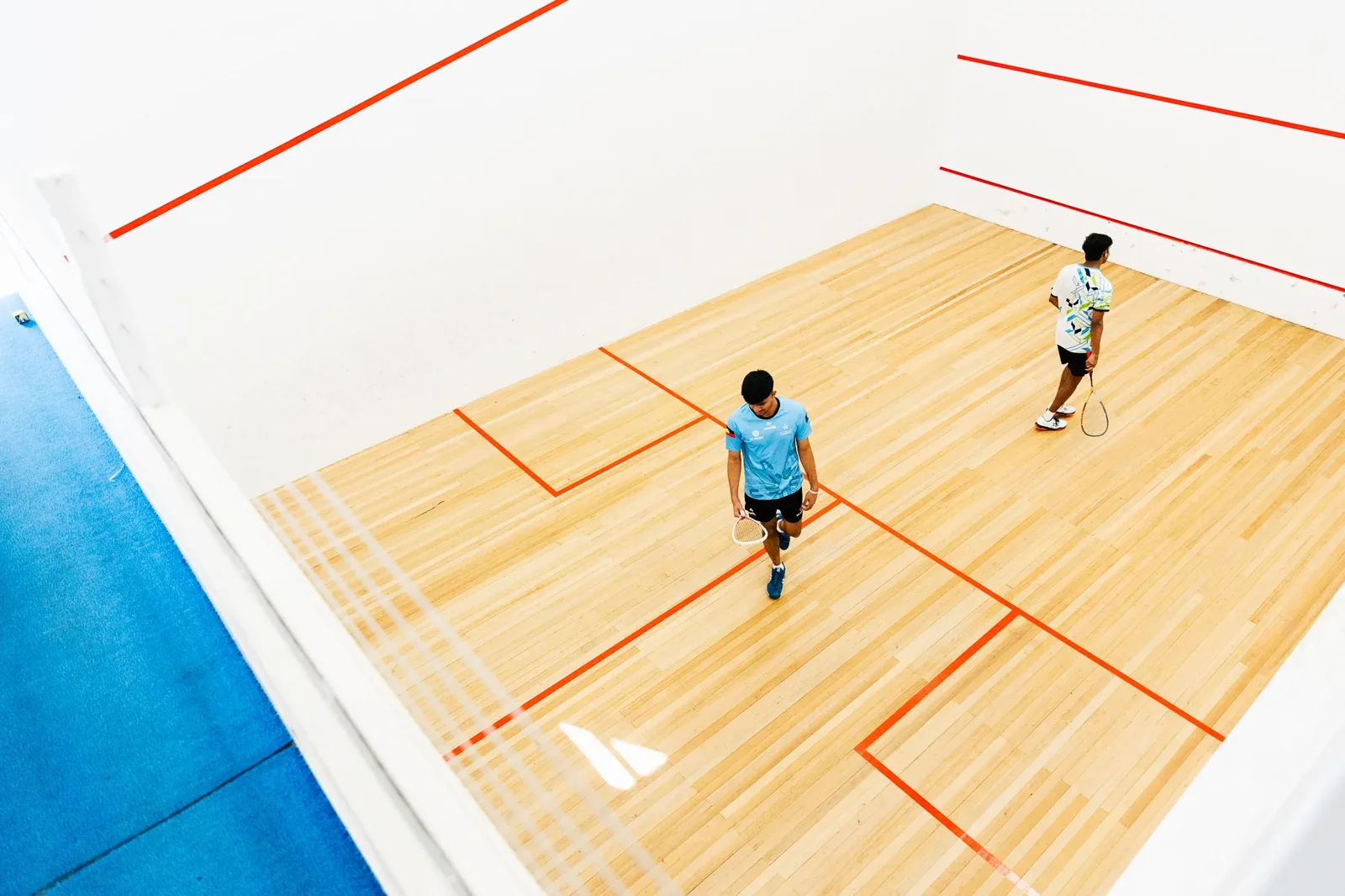
UCFitX, University of Canberra
Canberra · 3 courts
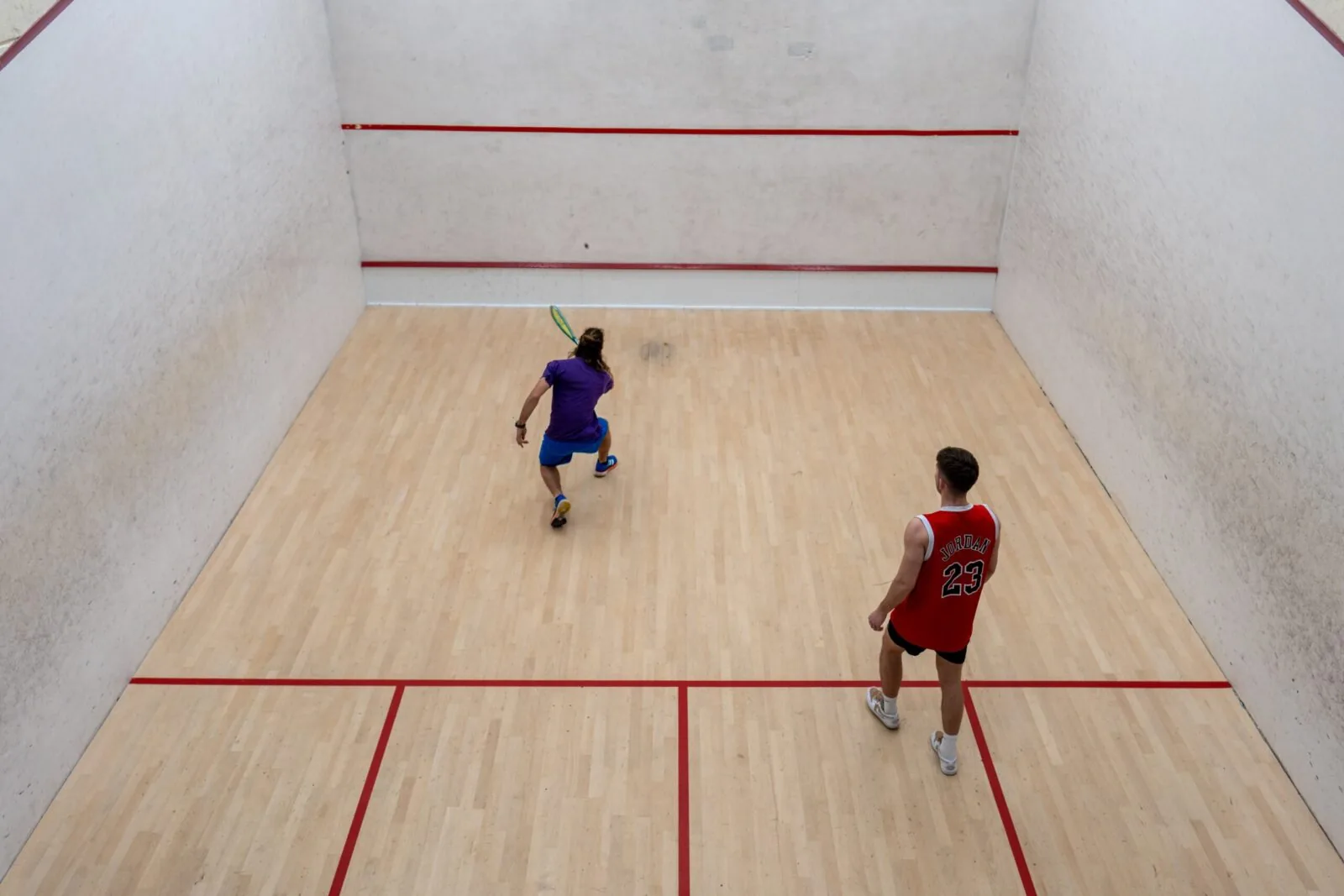
Oriam
Edinburgh · 8 courts
Glass courts
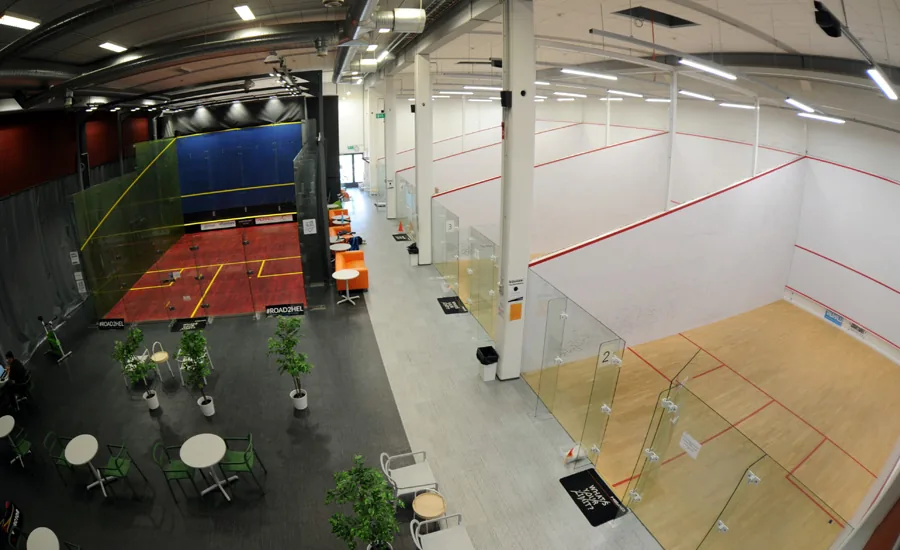
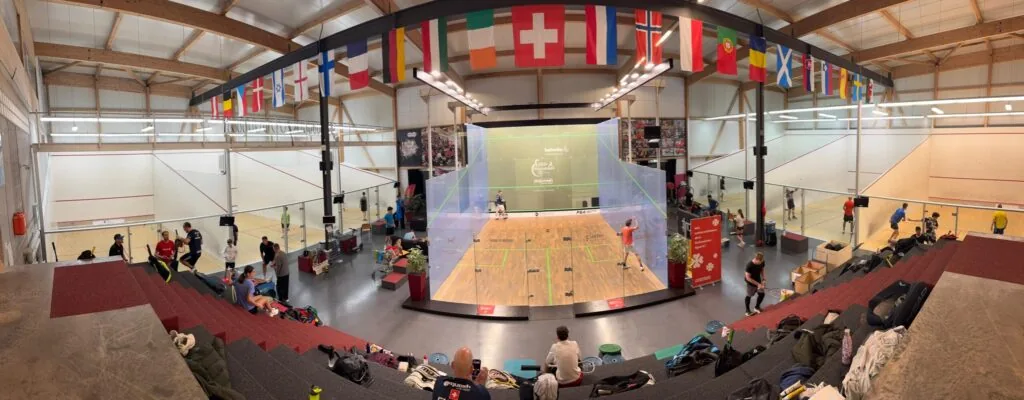
Many clubs have a glass back wall so people can watch from behind. The dimensions are exactly the same. If the glass is only 2.13 m high, the top of the glass itself becomes the back wall line. If it is taller, a line is marked on the inside of the glass.
Four-sided glass show courts, used for big tournaments, are also built to the singles plan. They can be put up in halls, shopping centres or outdoors. Glass squash courts explains how they differ to play on.
Doubles and hardball courts
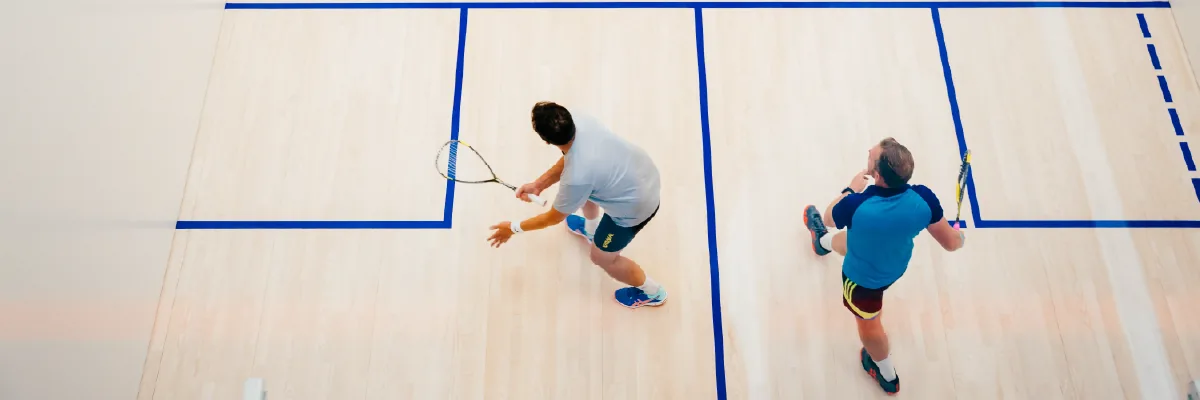
| Court | Length | Width | Tin height |
|---|---|---|---|
| International singles | 9,750 mm | 6,400 mm | 480 mm |
| International doubles | 9,750 mm | 7,620 mm | 480 mm |
| Competition-width doubles | 9,750 mm | 8,420 mm | 330 mm |
| Hardball doubles (North America) | 13,716 mm (45 ft) | 7,620 mm (25 ft) | 430 mm (17 in) |
The international doubles court is the same length as a singles court but 1.22 m wider. The extra-wide competition version is used at events such as the World Doubles and the Commonwealth Games. A doubles court can only be used for singles if it has a movable side wall that can be shifted in to 6.4 m.
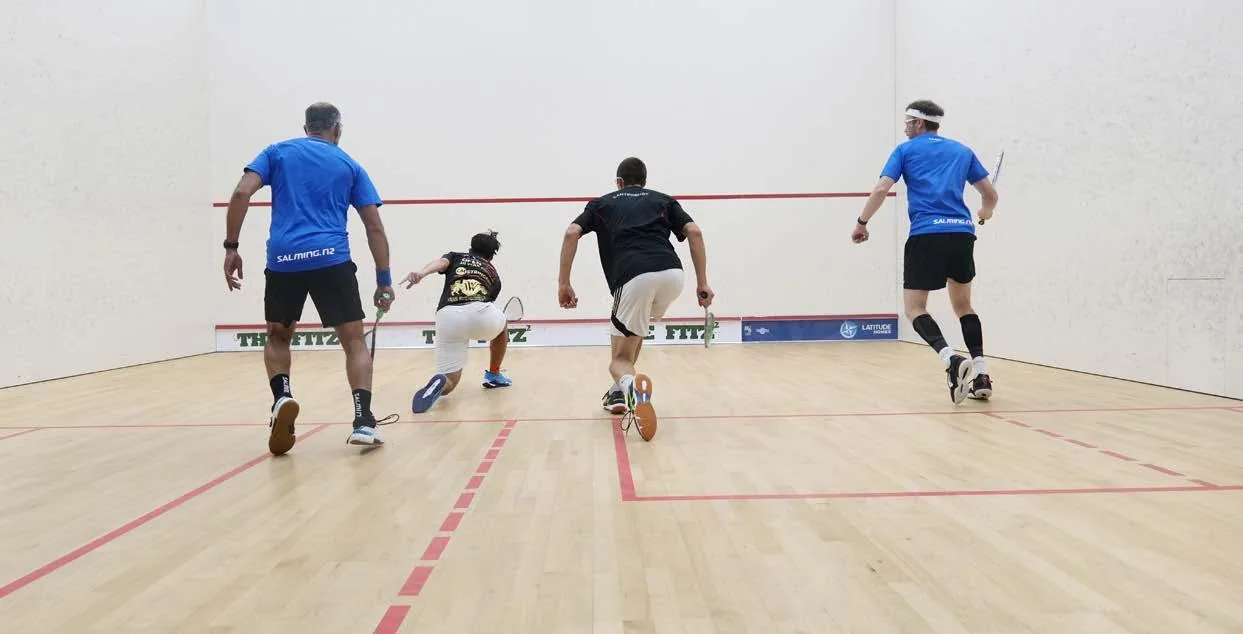
Hardball doubles is a separate North American game played with a hard ball on a much longer court. You will only meet it at a few clubs in the United States and Canada. Doubles squash covers how the game is played.
How big a squash court feels
The playing floor is about 62 m². That is smaller than a badminton court and roughly a third of a singles tennis court. With two players, two rackets and a fast ball in that space, the court feels small the first time you step on it, which is why clearing the ball and moving to the T matter so much.
If you are thinking of building a court rather than booking one, what it costs to build a squash court covers the space and budget you need.
FAQ
How big is a squash court in feet?
A singles court is 32 ft long and 21 ft wide. The front wall out line is 15 ft high, the service line about 5 ft 10 in and the top of the tin about 19 in.
How high is the tin on a squash court?
The standard tin is 480 mm (19 in) to its top edge. Professional tournaments often lower it to 430 mm (17 in), and extra-wide doubles courts set it at 330 mm.
How high does a squash court ceiling need to be?
The WSF specification asks for at least 5.64 m of clear height over the playing area, reducing to 5 m right by the front wall and 4 m near the back wall.
Are all squash courts the same size?
All international singles courts are built to the same 9.75 m by 6.4 m plan. Older courts and doubles courts can differ, and North American hardball doubles uses a much longer court.