Squash referee calls explained
 By the Find My Squash Court team·
Updated ·
6 min read
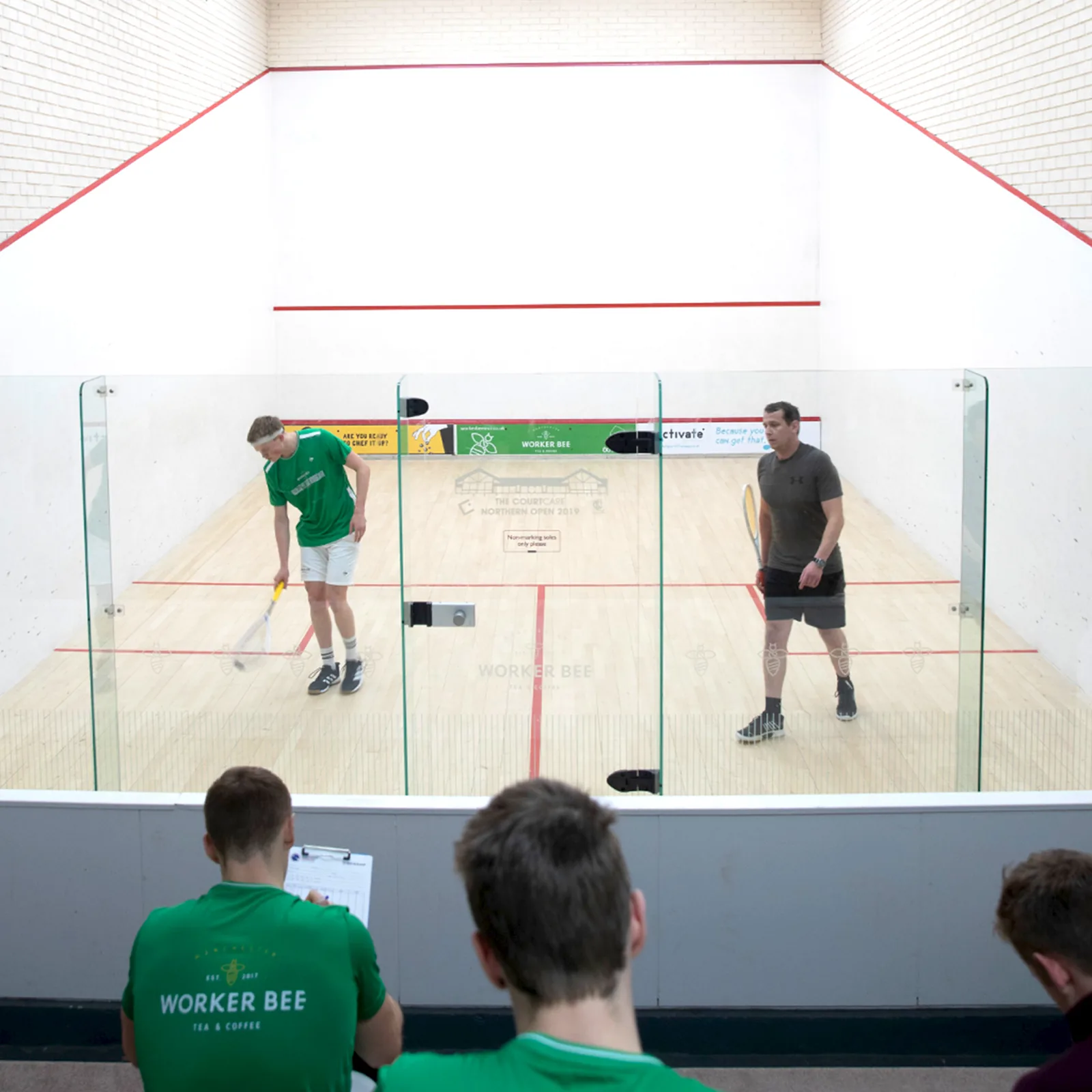
In a refereed squash match, two officials sit behind the back wall and speak in a fixed set of short calls. Once you know what each one means, the commentary at a tournament or the marker in your league match makes complete sense.
The short answer
Squash referee calls come from two officials. The marker calls the play and the score: "fault" for a bad serve, "down" when the ball hits the tin, "out" when it hits on or above the out-line, "not up" for a double bounce or carry, then the score with the server's score first and "hand out" when the serve changes. The referee decides lets and appeals with "yes, let", "no let" or "stroke to" a player, and handles time and conduct with calls such as "time" and "conduct warning".
Marker and referee
Under the World Squash singles rules, a match is officiated by a referee, or by a referee and a marker. They sit at the centre of the back wall, just above the out-line. In club and league squash it is common to have a single official, who acts as both. Players can then appeal a call made as marker to the same person as referee.
- The marker announces the match, calls faults and returns that are not good, and calls the score after every rally.
- The referee has the final say. They decide every let request and appeal, correct the marker, keep time and deal with conduct.

The marker’s calls
| Call | Meaning |
|---|---|
| Fault | The serve was not good, so the receiver wins the rally |
| Down | The return hit the tin, or the floor before the front wall, or the front wall and then the tin |
| Out | The return hit the wall on or above the out-line, hit a fixture above it, hit the top edge of a wall or left the court |
| Not up | The ball bounced twice, was not struck correctly (for example carried or double hit), or touched the striker |
| Stop | Players must stop play at once |
| Hand out | The serve has passed to the other player |
| Game ball | A player needs one point to win the game |
| Match ball | A player needs one point to win the match |
| 10-all: a player must win by 2 points | Called the first time a game reaches 10-10 |
| Yes, let / No let / Stroke to (player) | The marker repeats the referee’s decision on a let request |
If the marker is unsure about a serve or return, the rules say they must make no call. Silence means play on. Zero is called "love", so a game starts at "love-all".
A serve on the line is a fault. A serve that hits the service line on the front wall, or lands on the short line or half-court line, is a fault. Lines count as out in squash.
The referee’s calls
| Call | Meaning |
|---|---|
| Yes, let | The let request is allowed and the rally is replayed |
| Let | The rally is replayed when nobody asked, for example after a ball breaks or a distraction |
| No let | The let request is refused, so the player who asked loses the rally |
| Stroke to (player) | That player wins the rally because of interference |
| Half-time | Two minutes of the four-minute warm-up have passed and players change sides |
| Fifteen seconds | Fifteen seconds of an interval remain |
| Time | The interval or warm-up is over |
| Conduct warning | A formal warning for behaviour, such as delaying play or dissent |
| Conduct stroke / game / match | A penalty that gives the opponent a point, a game or the match |
When to give a let or a stroke is the hardest part of refereeing. Our guide to let vs stroke explains the interference rule.
Swansea Tennis and Squash Club
Swansea · Glass-back show court

St George’s Hill Lawn Tennis Club
Woking · All-glass court

Henderson Squash Club
Auckland · TV-ready centre court
How the calls are put together
The marker calls things in a fixed order: first anything that changes the score, such as a stroke; then the score, server first; then a comment on the score, such as game ball. Some typical calls from the rules:
- "Not up. Hand out, 4-3." The server's shot bounced twice, so the receiver wins the point and the serve, and now leads 4-3.
- "Yes let, 3-4." The rally is replayed. The server still trails 3-4.
- "Stroke to Jones, 10-8, game ball." Jones wins the rally and needs one more point.
- "Fault, hand out, 8-3." The server faulted. The receiver now serves at 8-3 up.
At the end of a game the marker calls the score and the game count, for example "11-7, game to Jones. Smith leads 2 games to 1." Squash scoring explains why the server's score always comes first.

Appeals and let requests
Players talk to the officials with two phrases.
- "Let, please." Used when your opponent got in your way. It counts as a request for a stroke too.
- "Appeal, please." Used to challenge a marker's call or lack of call, for example if you think your opponent's shot was down. The loser of a rally can appeal at the end of it, and either player can stop play to appeal a missed call.
If the marker's call was wrong, the referee usually orders a let, unless the call interrupted a winning shot, in which case that player wins the rally. If the marker missed a ball that was not good, the rally goes to the other player. The referee's decision is final, and arguing with it can bring a conduct penalty.
Video review in professional squash
At professional events with the technology, a video referee backs up the match referee. In a best-of-five match each player has two reviews, plus one more if the match reaches a fifth game. Players can review "stroke", "yes let" and "no let" decisions and pickup or double-hit calls, but not line or tin calls. A player who is proved right keeps the review.
The calls are the same in club and league squash, just with one official instead of three. Cities with the most squash leagues in our directory:
FAQ
What does hand out mean in squash?
It means the serve has passed to the other player because the receiver won the rally. The marker says it before calling the new score.
What is the difference between down and not up?
Down means the ball hit the tin or the floor before reaching the front wall. Not up means the striker hit the ball after its second bounce, carried or double hit it, or the ball touched them.
Why does the marker call the server’s score first?
The World Squash rules require the server’s score to be called first, so 6-4 means the server has 6 and the receiver 4.
Can you argue with a squash referee?
You can appeal a marker’s call or request a let, but the referee’s decision is final. Dissent towards an official can be penalised with a conduct warning or worse.