A short history of squash
 By the Find My Squash Court team·
Updated ·
5 min read
Squash began as a schoolboy variation on an older game, played with a softer ball against whatever walls were handy. It took a century to settle its rules, its court and its scoring, and it reaches the Olympics only in 2028.
The short answer
Squash grew out of rackets, a fast game first played in London's debtors' prisons. Around 1830, pupils at Harrow School found that a punctured, softer ball "squashed" against the wall and made for a slower game with more variety. Harrow built its first courts in 1864. The US formed the first national association in 1904, and England's Squash Rackets Association followed in 1928. The women's British Open began in 1921, the men's in 1930. Point-a-rally scoring to 11 became the standard in the 2000s, and squash joins the Olympics at Los Angeles 2028.
From rackets to squash
The parent game is rackets, played with a hard ball on a large walled court. Its roots are in the debtors' prisons of 18th and 19th century London, such as the Fleet, where inmates hit balls against the prison walls. It moved into public schools, Harrow among them.
At Harrow, boys waiting for the rackets court began knocking up against other walls with a softer, punctured ball. That ball did not fly off the wall in the same way. It "squashed", and the game that grew around it took the name. The softer ball meant players had to move and think more, and rallies lasted longer. Our guide to why it is called squash has more on the name.
Harrow built four outdoor courts in 1864, usually counted as the first purpose-built squash courts.
Courts and rules settle down
For decades every court was a little different. Country houses, schools and clubs built their own, and the game was played by local rules. Standardising took a long time:
- 1904. The United States Squash Racquets Association was formed in Philadelphia, the first national squash body. American squash went its own way with a harder ball and narrower court, known as hardball.
- 1923. The Royal Automobile Club in London hosted a meeting to agree rules and court sizes.
- 1928. The Squash Rackets Association was founded in England, today's England Squash. It fixed the court and ball standards that became the international game, sometimes called softball squash.
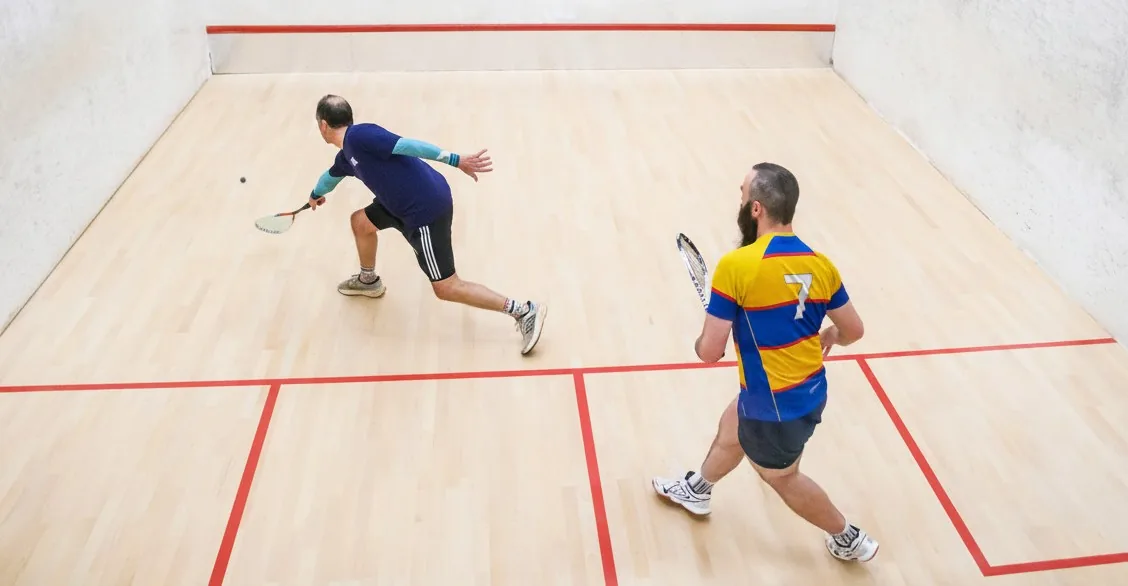
The court that came out of this period is the one you still play on: 9.75 m long and 6.4 m wide, with a tin at the bottom of the front wall. See squash court dimensions for all the measurements.
How squash spread
Squash travelled with the British Army, the civil service and British schools. By the middle of the 20th century it was played across the Commonwealth, especially in Australia, New Zealand, South Africa, India, Pakistan and Egypt. Officers' messes, cricket clubs and tennis clubs added courts.
In North America the first court was built at St. Paul's School in New Hampshire in 1884. Hardball dominated there for most of the century before the international softball game took over.
Cardiff Squash & Racketball Club
Cardiff · Founded 1937
Leicester Squash & Racketball Club
Leicester · Founded 1936
Hamilton Squash and Tennis Club
Hamilton · Founded 1936
The professional era
The British Open was squash's big title for decades. The women's event began in 1921 and the men's in 1930, at first decided by a challenge match against the holder, then as a knockout from 1947.
The game produced some extraordinary runs. Australia's Heather McKay won 16 British Open titles in a row from 1962 to 1977 and was unbeaten in competitive matches over that period. Pakistan's Hashim Khan started a family dynasty in the 1950s, and Jahangir Khan went about five years without losing a match, winning 555 in a row in the 1980s. Jansher Khan followed in the 1990s.
The World Open, the sport's world championship, started in 1976. Professional tours for men and women grew in the 1970s and 1980s, and squash boomed in the UK at the same time, with courts built in leisure centres up and down the country.
Modern squash
Three changes shaped the game you see today.
- Scoring. For most of its history squash used hand-in, hand-out scoring to 9, where only the server could score. The World Championships used point-a-rally to 15 from 1989 to 2003, and the professional association switched to 11 in 2004. The World Squash Federation confirmed point-a-rally to 11 as the standard in 2009. Our scoring guide explains it.
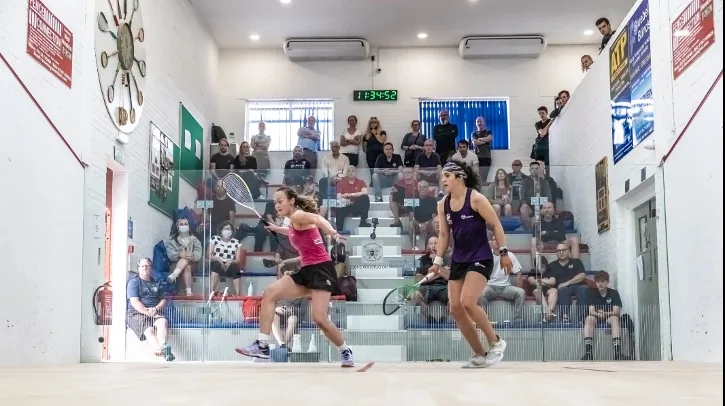
- Glass courts. Glass back walls, then all-glass show courts, let crowds and cameras see the game. Portable glass courts have been set up in a New York train station and beside the pyramids at Giza.
- The Olympics. After missing out for London 2012, Rio 2016 and Tokyo 2020, squash was approved for Los Angeles 2028. Read squash at the 2028 Olympics.
Egypt has been the leading squash nation since the 2010s, in both the men's and women's game.
Timeline
| Year | Event |
|---|---|
| c. 1830 | Harrow pupils play with a softer, squashier ball |
| 1864 | Harrow builds four outdoor courts |
| 1884 | First North American court, St. Paul's School |
| 1904 | US Squash Racquets Association formed |
| 1921 | First women's British Open |
| 1928 | Squash Rackets Association founded in England |
| 1930 | First men's British Open |
| 1976 | First World Open |
| 1998 | Squash enters the Commonwealth Games |
| 2004 | Pros adopt point-a-rally to 11 |
| 2023 | IOC approves squash for LA28 |
| 2028 | Olympic debut in Los Angeles |
FAQ
Where was squash invented?
At Harrow School in north-west London, around 1830, as a variation on rackets played with a softer ball.
Why is it called squash?
The soft ball squashed on impact with the wall, unlike the hard ball used in rackets.
When did squash scoring change to 11 points?
Professional squash moved to point-a-rally scoring to 11 in 2004, and the World Squash Federation confirmed it as the standard in 2009.
Who is the most successful squash player ever?
Heather McKay and Jahangir Khan are the usual answers. McKay won 16 British Opens in a row, and Jahangir Khan went more than five years unbeaten.