How to warm up for squash
 By the Find My Squash Court team·
Updated ·
5 min read
Squash asks for flat-out sprints, deep lunges and sudden twists within a minute of stepping on court. A short warm-up before you go in makes those first rallies safer and better, and it takes less time than most people think.
The short answer
Warm up for squash in two parts. Off court, spend 8 to 10 minutes raising your pulse with light jogging or skipping, then move through dynamic stretches: leg swings, walking lunges, hip openers, arm circles and trunk rotations. Finish with a few short sprints and shadow swings. On court, use the knock-up to warm the ball and groove your strokes, hitting length on both sides before any volleys or drops. Save long static stretches for after the game.
Why squash needs a proper warm-up
Few sports load the body as quickly. The first rally can have you lunging into a front corner, turning, then pushing back to the T, all inside a few seconds. Cold calf muscles, hamstrings and Achilles tendons cope badly with that, and so do lower backs that have been sitting at a desk all day.
A warm-up raises the temperature of your muscles, gets your heart rate up gradually and takes your joints through the ranges they will use on court. It also switches your brain on: your timing and footwork are sharper after a few minutes of movement than straight out of the car park.
Calf and Achilles strains are common in squash, and they often happen early in a match or in a short burst after a long pause. Our guide to common squash injuries covers them in more detail.
A 10-minute routine off court
Do this in the corridor, a corner of the gym or outside the court while the previous pair finish. You do not need any kit.
- Pulse raiser, 3 minutes. Light jogging on the spot, skipping, side steps and heel flicks. You want to feel warm and breathe a bit harder, not be tired.
- Lower body, 3 minutes. Ten leg swings forwards and back on each leg, ten side to side. Walking lunges with a twist towards the front leg. Deep squats, slowly. Calf raises, then a few gentle hops on the balls of your feet.
- Upper body, 2 minutes. Arm circles both ways, big and small. Trunk rotations with your arms out. Shoulder rolls. Swing your racket slowly through forehand and backhand, getting faster each time.
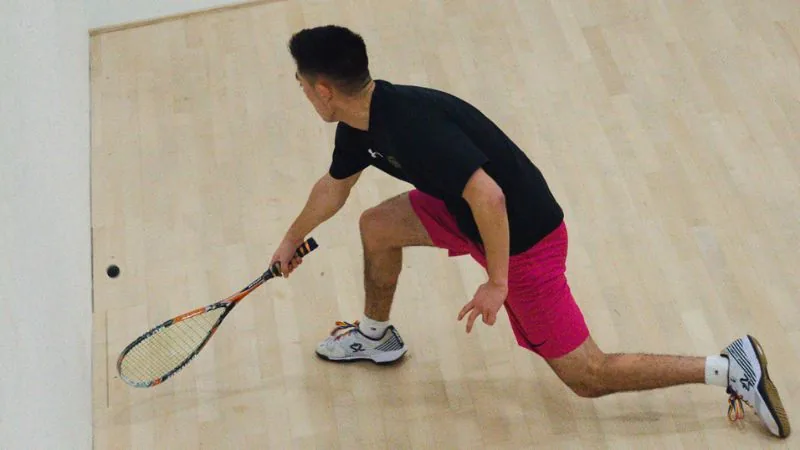
- Movement, 2 minutes. Shadow a few court movements: step to a front corner and lunge, push back to the centre, then side step to the back. Finish with three or four short sprints of five or six steps.
This is the same idea as ghosting, done gently. If you already ghost as training, a slow set of six to eight ghosted movements makes a good final part of the warm-up.
Dynamic, not static. Holding a stretch for 30 seconds before playing does little to prepare you for sprinting and can leave muscles feeling flat. Keep stretches moving before the game and hold them afterwards.
The knock-up on court
Once you are on court, the knock-up has two jobs: warming the ball and warming your strokes. A cold squash ball barely bounces, so the first few minutes always feel slow. Our guide on why you warm up a squash ball explains the rubber and the air inside it.
In a match, the rules allow a warm-up of up to four minutes on court, with players changing sides after two. In a friendly game you can agree something looser, but the shape is the same:
- Start with straight drives to a length on your forehand side, hitting firmly to heat the ball.
- Add a few volleys once the ball is bouncing properly.
- Hit a few boast shots and drops so your short game is not cold for the first rally.
- Swap sides and repeat on the backhand.
Hit the ball back to your partner rather than to yourself the whole time. Hogging the ball in the knock-up is a classic piece of poor squash etiquette.
Oxford Brookes Sport, Headington
Oxford · One squash court
Hiscoes Gym Surry Hills
Sydney · Glass-backed courts
Abbeydale Squash & Fitness Club
Sheffield · All-glass court
Cold courts and early starts
Some club courts are unheated, and a 7am or winter evening booking can mean a cold floor, a cold ball and cold muscles all at once. On those days:
- Keep a tracksuit top or long sleeves on for the knock-up and the first game.
- Make the off-court part a little longer, closer to 12 or 15 minutes.
- Expect the ball to stay slow for longer, and do not force your first lunges into the corners.
If you are over 40 or coming back after a break, the warm-up matters more, not less. The guide to playing squash over 50 has more on easing in.
After the game
Walk around for a few minutes rather than sitting straight down. Then hold some static stretches for 20 to 30 seconds each: calves against the wall, hamstrings, hip flexors in a half-kneel, quads, glutes and your shoulders. Drink some water, and get out of damp kit before you cool down.
If you train for squash fitness, the guide to squash fitness covers conditioning sessions that make the warm-up feel easier over time.
FAQ
How long should a squash warm-up take?
About 8 to 10 minutes off court, then the knock-up on court. On a cold day or if you are older or returning after a break, take a few minutes more.
How long is the warm-up in a squash match?
Under the rules the on-court warm-up lasts up to four minutes, and players change sides after two.
Should I stretch before playing squash?
Use moving stretches such as leg swings, lunges and arm circles before you play. Keep longer held stretches for after the game.
Is the knock-up enough as a warm-up?
Not on its own. The knock-up warms your strokes and the ball, but it does not prepare your legs for full lunges and sprints. Do a short warm-up off court first.